Roomies
A P2P app for young adults that turns daily routines into shared challenges to build accountability through human connection.
✦ Selected for the Summer Workstation at the Institute of Higher Education Innovation, Yonsei University
"I feel more motivated when the one keeping me accountable is a real person. I often ignore app notifications, and machines become boring over time." — P2
The challenge
86% of young adults had their daily routines disrupted, and the assumed fix was a better tool to manage them.
Sleep, meals, exercise, and social interaction were all off track. The instinct was to design a smarter tool: something that could track habits, send timely reminders, and fill the gaps through the devices people already used. We were trying to fix the problem directly.
"How much has your daily routine changed since COVID-19?" — 65 young adults surveyed
Also reported: significant changes in stress levels, screen time, and sleep duration.
The Insight
Interviews revealed the problem was not a lack of tools. What they were missing was a real person on the other side.
Automation was already everywhere, and people were still struggling. Notifications get ignored. Machines feel impersonal over time. What actually moves people is knowing that a real person is on the other side, waiting for them to show up.
The Idea
Roomies pairs strangers based on shared habits, building accountability through a real person rather than an automated reminder.
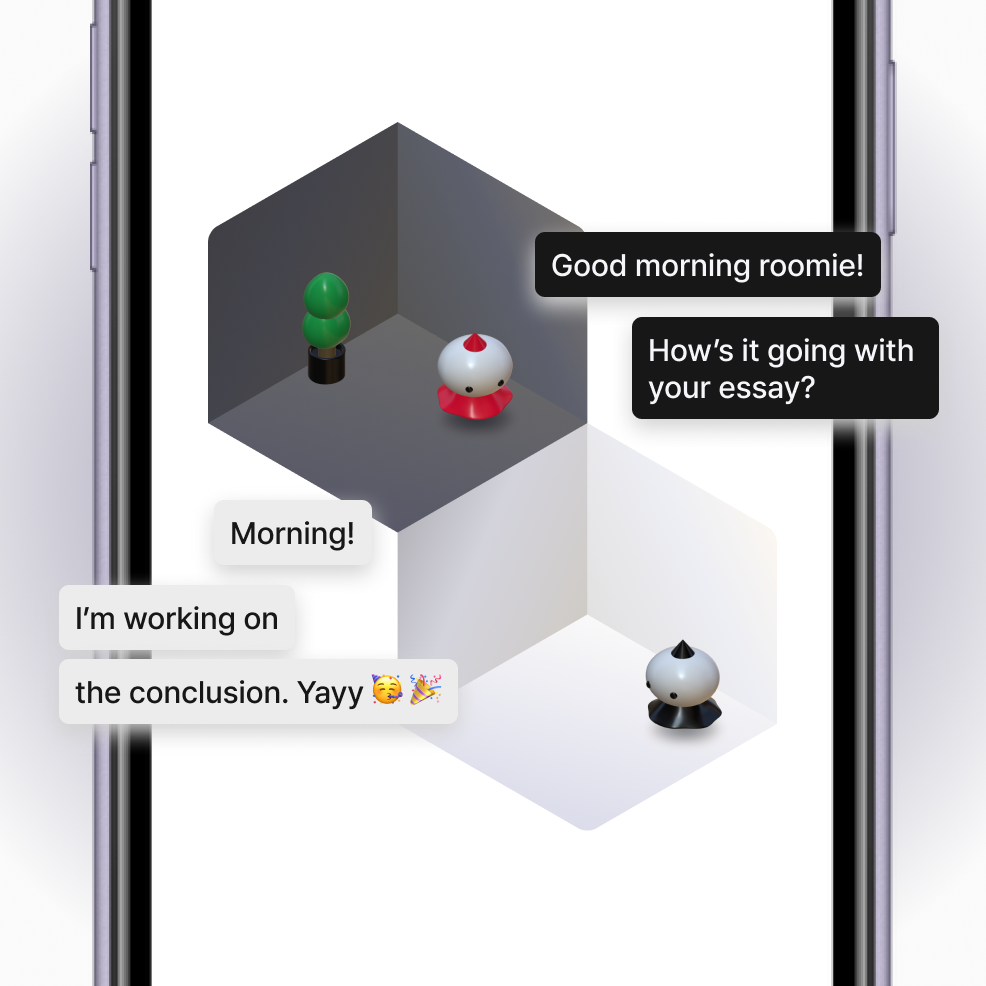
Each user has their own virtual room. When a challenge begins, the two rooms connect. Users set a task together, check each other's progress, and submit proof when it is done. The accountability is built into the structure, not pushed through notifications.
Visual Language
The visual identity needed to feel playful without making the product feel trivial.
The visual language was intentionally playful, with isometric rooms, characters inspired by garden gnomes and ghosts, and a bold color palette. The goal was to make a routine feel like something worth showing up for, not a checklist to get through.
Testing
All 10 users connected with the core concept immediately, with no major usability friction.
10 participants tested the prototype. No major usability issues were found, but more importantly, the idea resonated immediately.
"Having other people look after me would motivate me a lot. That is the main reason for my unproductivity, not having a supervisor." — P3
Reflections
Challenges
- Designing a system that creates genuine accountability between strangers who have never met
- Making the digital space feel personal enough to motivate someone on a hard day
- Keeping the visual identity playful without making the product feel unserious
Accomplishments
- A concept that resonated deeply enough to survive user testing without major usability issues
- Selected for a national research program with mentorship and funding
- Proved that social accountability works across cultural and timezone differences
Learnings
- Accountability needs a face on the other side to feel real. A system cannot replicate that
- Playfulness and structure are not opposites. One makes the other worth using
Beyond the Pandemic
Roomies was built during lockdown, but the insight behind it has nothing to do with it.
Roomies was conceived during the pandemic, but the insight it is built on has nothing to do with lockdowns. People have always needed other people to stay on track. That is not a pandemic problem. That is just how motivation works.
"Turns out the best motivation is just someone who notices when you don't show up."